Blog

Notes on software, AI agents, and engineering culture. They appear first, in Russian, on the Telegram channel The Leaning Ivory Tower.


I like posting manifestos. Lately, most of them have been of the "we no longer need the meatbags" variety. For a change of pace, here is Ivan Turković's manifesto on artisanal coding.

Artisanal coding: a manifesto for a new era of craftsmanship

Picture a carpenter. They use power tools, but know when to stop and sand a surface by hand. They can feel the material and understand how it behaves. Each piece gets individual attention until it is right.

Artisanal coding follows the same principles:

- Understand the problem before you start writing code.

- Every line should be a deliberate choice.

- Refactoring starts when you can feel that a solution is off. You do not need a tool to tell you.

- Fixing a mistake is only part of the job. Learn something from it.

We are losing our professional muscle memory. When vibe coding takes the place of thinking, skills atrophy. We risk going from people who build things to code operators, endlessly tweaking prompts and debugging someone else's solutions.

AI does not feel the resistance of the material. Working through that resistance is how we learn our craft. Artisanal coding leaves room for AI as a developer's assistant, a digital apprentice.

This is a declaration of independence, a call to slow down, think harder, and stay connected to the things we make. If vibe coding is programming's fast food, artisanal coding is a meal cooked slowly, with care and attention. Yes, it takes longer.

Read Ivan Turković's full manifesto.

Discuss in the Telegram channel


Heard about those supposedly mythical Chinese services reselling Claude and other American models for 10-20% of the usual price?

They are not that mythical. Here is one I tried myself. The pricing is impressively sneaky: you buy yuan, they land in your account as dollars, and usage is charged at the models' API rates, with another discount on top.

I gave it a go. Seems to work as advertised. Still more expensive than a subscription, but cheaper than paying for the API directly. I have kept it as a fallback for when I hit my limits.

Discuss in the Telegram channel


Since Claude banned me, I decided to run a comparison: OpenAI versus the Chinese contender, GLM.

For the test, I decided to hack my old robot vacuum and put AI in it. Read or watched Zima Blue? That was the plan. The guinea pig was a Xiaomi (Roborock) I had rooted a while back. The task: drive around with the lidar on and the brushes off, controlled through ROS 2/RViz.

OpenAI's GPT 6.1 Sol went first. It got off to a good start: figured out the network interface and motor commands, read the lidar. Then it started disassembling the firmware and spent two solid days hammering away, telling me all sorts of lovely things about its internals. Actual results: fuck all. Stuck.

I switched to GLM-5.3. In one session, it pulled a table of all the devices out of the binary, checked the command format against a recording of live traffic, and found the exact commands. A couple of hours later, it had written a ROS 2 adapter in Rust and a watchdog that stops the robot if the connection drops. The watchdog was in Perl, for some reason. I suppose there was nothing more suitable installed on the robot.

This is not the only time OpenAI has fucked up and GLM has come in and sorted things out. To make matters worse, OpenAI takes forever to fuck up. The servers are that slow.

To be fair, OpenAI's top model is GPT 6.0 Astra. But the Codex subscription gives every model the same token allowance, which they burn through at a rate determined by how capable they are and how much of a crafty bastard Sam is. Anthropic's top model, Fable, has a separate allowance. Using Astra, I burned through a week's worth of the $200 Codex subscription in a single day.

So far, GLM-5.3 leads 2-0.

Discuss in the Telegram channel


Claude has started screwing everyone over mass-banning VPN users. I got caught in it too.

So I bought a Codex subscription. OpenAI must be getting drunk celebrating all the new customers. I installed CLIProxyAPI and launched the same old Claude Code like this:

#!/bin/bash -e
export ANTHROPIC_BASE_URL="https://mop.corp.ermak.dev/llm"
export CLAUDE_CODE_ENABLE_GATEWAY_MODEL_DISCOVERY=1
export ANTHROPIC_AUTH_TOKEN="xxxxxxxxxxxxxxxxxxxx"
export NODE_TLS_REJECT_UNAUTHORIZED=0
export CLAUDE_CODE_MAX_CONTEXT_TOKENS=1000000

exec claude --dangerously-skip-permissions "$@"

I have not noticed much difference between gpt-6-sol and glm-5.3. GPT is painfully slow, though. Looks like everyone has piled onto it.

Discuss in the Telegram channel


If you are sick of juggling secrets and want to keep them encrypted in Git, here is a pre-commit hook:

#!/usr/bin/env bash
set -euo pipefail
[ -f ~/.secrets-key ] && [ -d secrets ] || exit 0
pack() { tar -c --format=ustar --sort=name --owner=0 --group=0 --numeric-owner --mtime=2000-01-01Z secrets | gzip -n9; }
salt=$(pack | sha256sum | cut -c-16)
{ printf Salted__; xxd -r -p <<<"$salt"; pack | openssl enc -aes-256-cbc -md sha256 -pbkdf2 -iter 200000 -S "$salt" -pass file:$HOME/.secrets-key; } >secrets.tar.enc
git add secrets.tar.enc

Put the master password in ~/.secrets-key. The contents of the secrets folder in your working copy will be committed as secrets.tar.enc.

To decrypt:

openssl enc -d -aes-256-cbc -md sha256 -pbkdf2 -iter 200000 -pass file:$HOME/.secrets-key -in secrets.tar.enc | tar -xzf -

Ordinary encryption changes the output file every time and clutters up your Git history. The trick here is convergent encryption: we use the SHA256 hash of the contents as the salt for password-based encryption. If the folder's contents stay the same, so does the encrypted file.

I fucking love cryptography.

Discuss in the Telegram channel


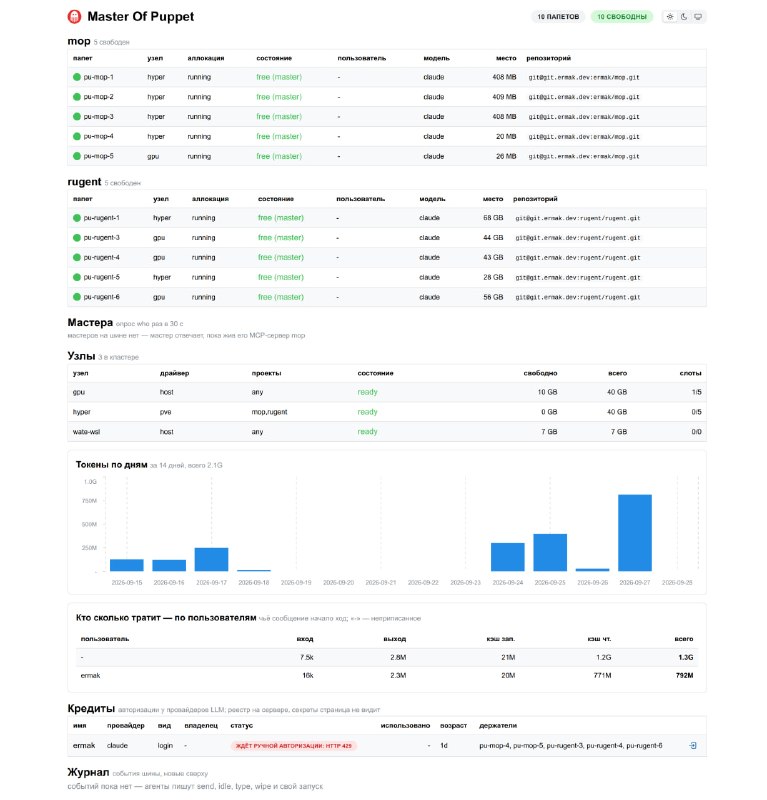
Master of Puppets dashboard showing agent pools, cluster nodes, daily and per-user token usage, and a Claude account waiting for manual authentication

An update to MOP.

1. Token usage statistics are in.

2. Multiple users and LDAP authentication.

3. You can now pool LLM accounts, currently Claude subscriptions and GLM API keys.

4. Sign in to Claude straight from the dashboard.

Under heavy use, Claude keeps asking you to authenticate again, and it does not like Playwright.

Looks like software development needs a new role: a human login attendant who watches for an LLM dropping out and signs back in.

Discuss in the Telegram channel


A few bits of industry news.

The US and China have agreed to call artificial intelligence "superintelligence". I support the initiative. We just need to adapt it to Russian folklore: something like "the All-Wise Mind". Alice the All-Wise, for instance.

A document regulating autonomous weapons has dropped the requirement for human control over military AI. They also removed the clauses saying the systems should work "predictably" and "reliably". Sensible enough, given that they will probably be vibe-coded.

The creator of Ruby on Rails has given up writing code by hand altogether. Says he likes English better than Ruby. At this rate, I will have to do all my programming in Russian profanity.

Discuss in the Telegram channel


As I said it would, Anthropic has delivered an orchestrator with cloud sandboxes. It works simply: it clones your repo onto one of its VMs and does the development there.

Anthropic makes Claude Code cloud sessions generally available

A long refactor, a migration or a dependency upgrade can now be handed to an agent in the cloud while you close the laptop. The feature is out of research preview, and the session runs on Anthropic's virtual machines.

You can start one from the web, mobile and desktop apps, or with the claude --cloud command. Runs can be scheduled, triggered through the API or by GitHub events, and companies can host the sessions on their own servers.

The feature is included in the Pro, Max, Team and Enterprise plans and draws on the shared subscription limits. Until October 7, Pro and Max subscribers can claim a one-off bonus of $100 and $250 respectively, spendable only on cloud sessions.

I poked at it. Container resources:

- RAM: 15 GB, no swap

- Disk: 30 GB free (the 252 GB that df shows is the whole physical disk; what you actually get is the session quota)

- CPU: 4 cores

The container is a full Linux in Firecracker, so Amazon is peeking out from underneath.

What it will cost is not clear yet, but most likely not much above AWS list prices.

So, friends, every last byte of your source code now lives on Anthropic's servers. If that is not to your taste, roll out MOP.

Discuss in the Telegram channel