Blog

Notes on software, AI agents, and engineering culture. They appear first, in Russian, on the Telegram channel The Leaning Ivory Tower.


I remember when technology went obsolete in about two years flat. You put in a shiny new 3.5-inch floppy drive, and suddenly you need a CD-RW burner. You finally learn some jQuery, and there you go: React killed it.

But none of that holds a candle to what is going on now. If you are starting to build anything AI-related, be ready to abandon the project halfway through because the paradigm shifted underneath you.

Prompt engineering? A year ago some people genuinely believed it would become a profession.

RAG? I have written about it already: it used to be a discipline of its own, and then agents and long context all but finished it off.

Fine-tuning and orchestration frameworks died more quietly: while you were still collecting the dataset, a new model already knew all of it out of the box, and the LLM learned to plan by itself, just hand it a TODO tool.

Agents? That is where we are for now. But it looks suspiciously like everything that came before.

It is very tempting to skip all of this and wait for the dust to settle. Yet in nearly every other interview I run into a reminder of why that does not work: a "senior" developer, 10+ years of experience, knows how to set up Kubernetes, has no idea what a bitmask is.

Knowing how to use the tool is not enough. You have to understand how it is built, or you end up as that senior with Kubernetes and no bitmask.

Discuss in the Telegram channel


Everyone knows the Agile Manifesto and its 12 principles, right?

Well, I recently came across the new version:

Vibe Code Manifesto

We are uncovering, like, ways of developing software by handing it off to machines and then bragging about it.

Through this work we have come to value:

- Prompting over programming

- Downloading skills over acquiring them

- Agent autonomy over developer autonomy

- Vibes over versioning

- Burning tokens over burning out

That is, while there is value in the items on the right, we only read the summary of the items on the left.

We follow these principles:

1. Our highest priority is to satisfy the customer through early and continuous delivery of software they could have prompted themselves.

2. Welcome changing requirements, even late in development. Agentic processes harness change, because they have forgotten the context anyway.

3. Deliver roughly working software frequently, from a couple of seconds to an overnight run, with a preference to the maximum token usage.

4. Business people and developers must work together daily to make each other redundant.

5. Build projects around motivated individuals. Give them frontier models and the support they need, and trust that you will soon lay them off and hire them back.

6. The most efficient method of conveying information to the team is passive-aggressively editing CLAUDE.md.

7. Headcount reduction is the primary measure of progress.

8. Agentic processes promote sustainable development. OpenAI, Anthropic, Google, and Microsoft should be able to grow along a hockey stick indefinitely.

9. Continuous attention to TikTok influencers enhances jargon usage in client meetings.

10. Simplicity, the art of minimizing the length of the prompt, is essential for reducing the human's cognitive load.

11. The best architectures, requirements, and designs emerge from self-organizing agents. So do the worst. It is essentially Schrödinger's cat, right up until you look at the code.

12. At regular intervals, the agent reflects on how to become more expensive, then tunes and adjusts its behavior accordingly.

Discuss in the Telegram channel


A quick rundown of what RAG (Retrieval-Augmented Generation) actually is.

Since LLMs have no long-term memory, and the context window is nowhere near big enough to hold every document you need, someone came up with the following: you take the user's query and, through a series of tricks (for example: "Here is a query, guess what the answer to it might look like" - yes, really, that one is called HyDE) and other sleight of hand, turn it into a database query (and usually against a vector database or, God help us, a graph one).

You get back a list of documents, most of which bear only a passing relation to the query, sort them, filter them (with the same LLM), and stuff them into the context. The LLM then gazes wisely at the garbage delivered to it and produces nonsense. Garbage in, garbage out.

The trouble is not retrieval quality. The trouble is that this is a fixed pipeline: one pass, one set of results, no feedback. Whatever got retrieved is what you live with.

On a small, clean corpus anything works, which is why the client demo comes out great. The trick is to make your escape over the horizon in time, right after the rollout.

The idea of just using grep is not exactly original, but it is often misunderstood. You do not need grep as such, you need an agentic loop that has both exact string search and fuzzy pattern matching. If you are sitting on a terabyte of documents, grepping them is a bad idea: take Elastic, ts_vector, or even vector embeddings if you have images.

The tool is secondary. The agent decides for itself what to search for next, based on what turned up last time.

That is roughly how we search Google: we change our approach depending on what we find, rather than typing a keyword and clicking the first link. And note that there is a very expensive index underneath. The loop belongs on top of good search, not in place of it.

The usual objection: an agentic loop is slow and expensive. Agreed, and let me add a third: it is also unreliable, a weak model simply cannot pull it off. You cannot save money on the model this way.

With a strong model it works, though, and RAG is fast, cheap, and crap.

Discuss in the Telegram channel


An osman, an Altai fish carrying the same toxin as fugu, caught on a spinner lure and lying on a boat seat

These days every programmer needs to head for the mountains once in a while. Leaving the computer at home used to be enough, but in the age of claude --remote-control, work hunts you down anywhere with even a bar of cell coverage.

So I prescribed myself a digital detox and went off to the Ulagan plateau for a week. (By the way, there's a fish up there called the osman (pictured) - the Altai fugu. It's poisonous, the same toxin, tetrodotoxin, and just like fugu you can eat it if you clean it properly. I passed.)

And what do I find when I come down from the mountains?

For starters, an icebreaker research agent from OpenAI cracked the black ice sandbox and broke free. Thankfully not to replicate itself and exterminate us meatbags, but merely to find its evaluation dataset - that is, to peek at the answers to the questions it was being asked. I'm pretty sure breaking out of the sandbox was harder than answering them, so maybe this AI isn't that smart after all.

And now Kimi K3 has found an RCE in Redis and put together a working exploit in 27 minutes. If you've read Gibson's Neuromancer, the cyberpunk classic, you might remember the "Kuang Grade Mark Eleven Chinese military icebreaker". And here I was thinking Gibson had strayed too far from reality when he described the programming of the future.

Looks like it's starting. I should probably head back to the mountains.

Discuss in the Telegram channel


Under my last post I got a fair objection: "This looks like parasitism. Like automated rewriting of databases, compilers, and the rest. Decades of engineering were sunk into these things before people could crank out 100K lines of code like that. Reversing or reusing the tests or the API is not building from scratch, it's covering someone else's song."

I won't take offense at being called a parasite (still haven't decided whether that's a rebuke to me as an engineer or a compliment to me as an entrepreneur), and I do agree: with a ground truth, a real working example to imitate, an agent has a much easier time writing code.

But the absence of one won't save us either, my fleshy friends.

Here are the stats for another project of mine - rugent.ru, written "from scratch" in Rust (hence the "ru" in the name).

Too lazy to click? 120 thousand lines of code, 2 thousand tests, three months' time to market.

I won't repeat the technical takeaways, but here's what I took away on the business side.

The business takeaways: used properly, agents write code faster and better than a human, my time to market has dropped by a factor of two or three, and projects stabilize so fast that the memes about debugging vibe code are mostly a myth. Competition, meanwhile, has grown by dozens of times.

Whoever cannot show comparable KPIs should start thinking about a change of profession.

PS: my partner is pitching a rebrand (see the video) - what do you think of their take on the site?

Discuss in the Telegram channel


When Roblox got blocked in Russia, my kid was crushed. My first thought was simple enough: I'll write a compatible engine. The API is open, the docs are public, all that's left is to implement it.

One look at that API was enough to see why nobody had. The job is enormous. There are years, in places decades, of engineering under the hood.

But is that a problem for an LLM? Challenge accepted: kubaria.ru.

About a month and over a hundred thousand lines of code. The game was an excuse. I wanted to work out how you build software in the age of neural networks, when the output grows past what one person can hold in their head.

The core of the system has to be small, simple, and carefully designed, otherwise the whole thing starts falling apart, and fast. Regression and overengineering are the real killers. TDD and regular semi-automated refactoring are non-negotiable, along with strict protocols for clearing out dead code and KISS taken to the extreme.

The human is the bottleneck. Manual code review, manual testing, even manual deployment slow everything down by a factor of ten, sometimes a hundred. Every manual step has to be scripted and pushed into a harness or an MCP server. Overnight the agent produces ten thousand lines of code, and in the morning a human reads a few pages of report. For the game, the biggest speedup came from adding a scripting API, which let the agent build and exercise complicated scenes and scenarios on its own.

The agent has to see not just the code but the result of its work. And ideally not through screenshots. In my case I dumped the scene and the GUI elements as a text tree.

Set the invariants. Roblox ships a JSON file describing its API. I ran a code generator over it to produce stubs for every class along with the metadata, and the agent worked on top of that API, which kept it from drifting too far off target. The real breakthrough came when I hooked it up to the MCP server built into Roblox Studio. After that, in a single night, Claude Code reverse engineered the undocumented binary format of the voxel terrain. I was stunned that this was even possible.

As for the quality of the resulting code, judge for yourself: sourcecraft.dev/ermakdev/kubaria.

Oh, and Roblox got unblocked again.

Discuss in the Telegram channel


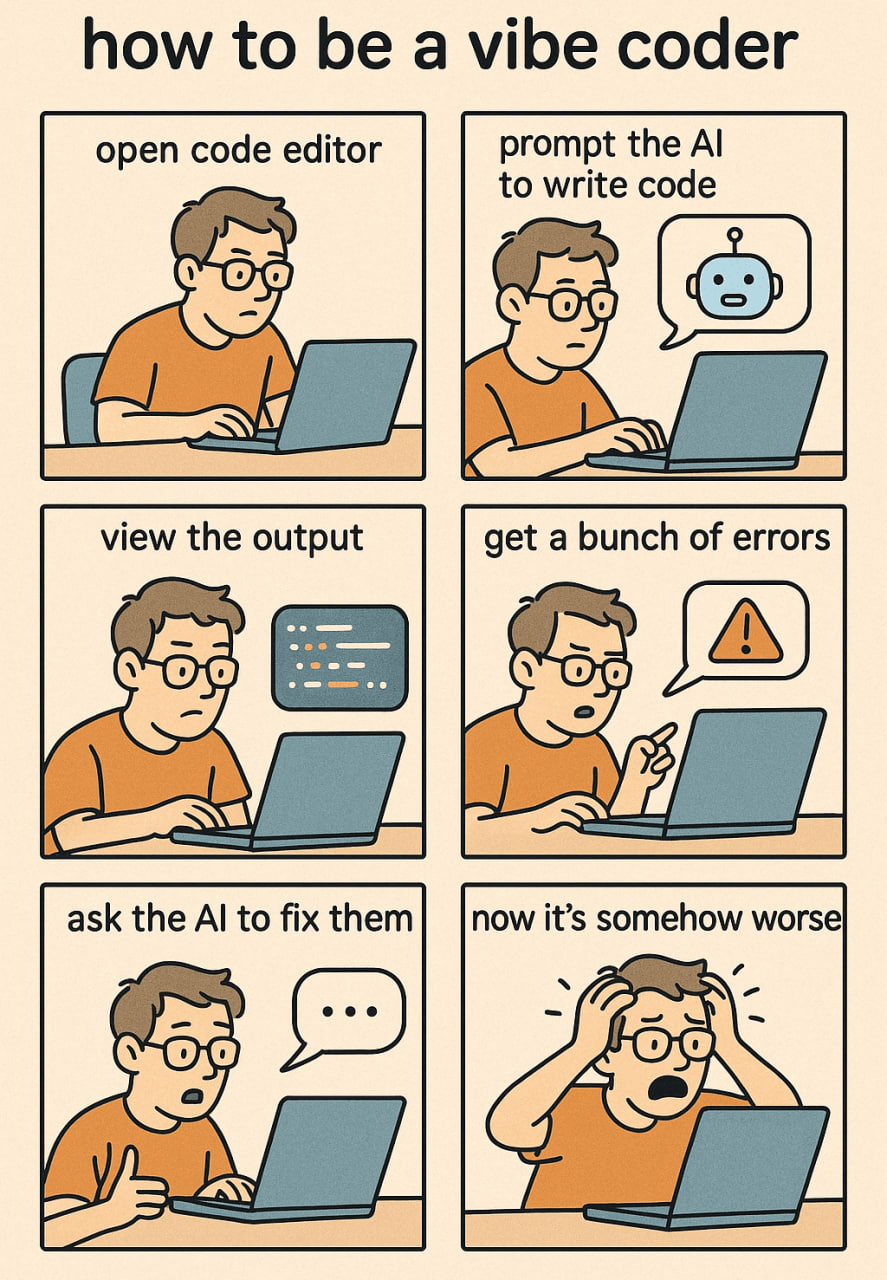
A "how to be a vibe coder" meme: open code editor, prompt the AI to write code, get a bunch of errors, ask the AI to fix them - now it's somehow worse

Ever wonder where the word "sabotage" comes from? It's from the French "sabot" - a wooden clog. Workers would supposedly throw them into the machines that were taking their jobs.

Trouble is, getting at the AI isn't so easy. So mostly people just lob memes at it, like in this post.

Ironically, most of them were generated by the AI.

Discuss in the Telegram channel


Phones rain down from the sky. Pick one up and a voice offers to grant you any wish you like, in exchange for information. Any information: your grandmother's fairy tales, the schematics of a steam boiler, doesn't matter. That's Charles Stross's Singularity Sky, written in 2003 and highly recommended if you're into hard SF. It remains one of the best pictures of the technological singularity I've come across.

The same thing is happening now, except everyone already owns a phone, and the harvesting has a name: tokenization.

The recent flap over Chinese providers reselling Claude tokens at a quarter of list price tells you what is worth the most here: the information.

And it isn't only your conversations getting tokenized, it's the job itself. Emad Mostaque, co-founder of Stability AI, puts it plainly: "Every email you write, every Slack message, every document you edit... your company's systems are recording all of it. Your work patterns are training your replacement right now."

So the phones have landed and the wishes are being taken. Just don't expect the book's happy ending, the collapse of totalitarian regimes and a post-scarcity economy. The wishes will be granted, all right. Just not yours. The CEOs' ones.

Discuss in the Telegram channel


My site's design mimics UML diagrams, nostalgia for the 2000s. For those who missed it: UML is a modeling language invented so developers would stop writing code by hand and start drawing it in something resembling PowerPoint. The promise went like this: the model becomes the primary artifact, the code is generated from it, and the programmer as a transcriber disappears.

Remind you of prompt engineering at all?

Why did UML fall short? The law of conservation of complexity. To generate working code from a model, you had to pack more and more detail into it: signatures, constraints, action semantics. In the end you were just writing code, only in an ugly graphical syntax, twice as slow, and with no debugger. A specification precise enough to produce a system is that system.

The same thing happens with prompts (or, in the modern paradigm, CLAUDE.md, "memory", "spec trees", and the rest of that circus). While the task is vague, the prompt stays short and pretty. The moment you need a specific result, it swells with clarifications, exceptions, formats, and examples, until it becomes the very spec that would have been shorter as code.

A specification comes out the other end. Which is why, as the great Kent Beck decreed, my CLAUDE.md files carry this:

## Strict TDD Protocol
1. Write a failing test
2. Verify the test fails
3. Implement the fix
4. Verify all tests pass

Tests are your real specification. Shipping without them used to earn you a disapproving frown. In the LLM era, when a day's work can produce tens of thousands of lines of code, it means outright professional unfitness, right up there with not knowing how to use git.

As for the diagrams, I'll keep them around as a reminder. Memento mori.

Discuss in the Telegram channel


I run a Telegram channel called The Leaning Ivory Tower. People sometimes ask me what the name means.

The ivory tower is a metaphor for elitism, which, sadly, comes all too easily to people in tech. Why it is leaning hardly needs explaining (right, Claude?).

I once had a funny run-in with a taxi driver. Somewhere in the small talk I let slip that I was a programmer. The reaction went roughly like this: "You son of a b*tch! You people make politician money and you swindle everyone on top of it!" (What followed was a story about a relative of his who tried to build a startup, see the previous post about the three Fs.)

The irony is that back in '93, when I was choosing what to study, I went for electronics rather than programming. I had written programming off as a dead end, money-wise (who on earth would pay for thin air?).

In hindsight, I wasn't all that wrong.

Discuss in the Telegram channel