Blog

Notes on software, AI agents, and engineering culture. They appear first, in Russian, on the Telegram channel The Leaning Ivory Tower.


On my current project I have been slacking off on refactoring a bit. OK, not a bit.

Over the past couple of months the tracker shows 1,200 closed tickets - features and bugs. Even I was like, holy shit.

The product works, everything is fine. So I decided to check on the core of the system - the message queue, which I run as a sort of commit log.

- One table has turned into two: some messages go into one, the rest into the other.

- The end-of-turn signal is sent from seven places. Five of them forgot.

- The catch-up logic is copy-pasted four times, each with a different limit. The fifth copy is the most honest of the bunch: fell behind? Who gives a fuck.

- Compatibility with the old journal format is guaranteed forever. The format itself was ripped the fuck out ages ago. Tests are green.

I will stop the list here.

I now have 1,237 tickets in the tracker.
Discuss in the Telegram channel


Agent pool script output: wk-cloudpub and wk-rugent workers marked busy or free, with free slots listed for the gamer, mirror and mate machines

Claude has a new feature - cross-session messaging - and it finally let me build a proper orchestrator.

Until now I simply ran 3-5 agents in terminal tabs, but since I write Rust, they kept dying of memory starvation during compilation or test runs. So I turned off the OOM killer, added swap, and felt like I was back in the Windows 95 days: every 5 minutes my mouse would freeze and I would sit there waiting for everything to unstick. Though credit where it is due to SSDs - swapping is no longer a death sentence if you set it up right.

I have a couple of machines sitting idle, but the ssh + tmux zoo wears me out.

So now I finally have a pool of agents managed by a single dispatcher (quickly hacked together on top of Nomad).

The orchestrator uses a script (see the screenshot) to create working copies in the pool, hands out tasks through a simple skill, and then sorts through the agents' branches and closes the tickets.

Now I can spin up 10 agents if I feel like it. One ring to rule them all!

Discuss in the Telegram channel


I have written before about the tech debt LLMs pile up in code, but the nastiest tech debt accumulates in "memory files", and we are the ones piling it on.

When the LLM screws something up, the first reflex is to add another "STOP FUCKING SWALLOWING ERRORS" to CLAUDE.md.

Over time it turns into an incoherent tantrum, and this is supposed to be the project's main document.

A memory file should be something like a manifesto, or a charter at worst. Do not turn it into a Talmud - LLMs were already trained on the actual Talmud.

I try to keep mine under 100 lines. Here is an example, if anyone is curious.

Discuss in the Telegram channel


I used to write tasks for Claude in English, but lately I gave up and just write them in Russian.

Claude, in turn, uses a pile of Russianized terms, for example:

- "Модзибейк" (mojibake) - broken text encoding

- "Грандфазерство" (grandfathering) - backward compatibility (at first I read it as дедовщина, the Russian word for hazing)

- "Самоматч" (self-match) - when ps aux | grep catches itself

- "Ампутация" (amputation) - removing dead code

My Runglish is getting more advanced by the day. Or is it AInglish?

Discuss in the Telegram channel


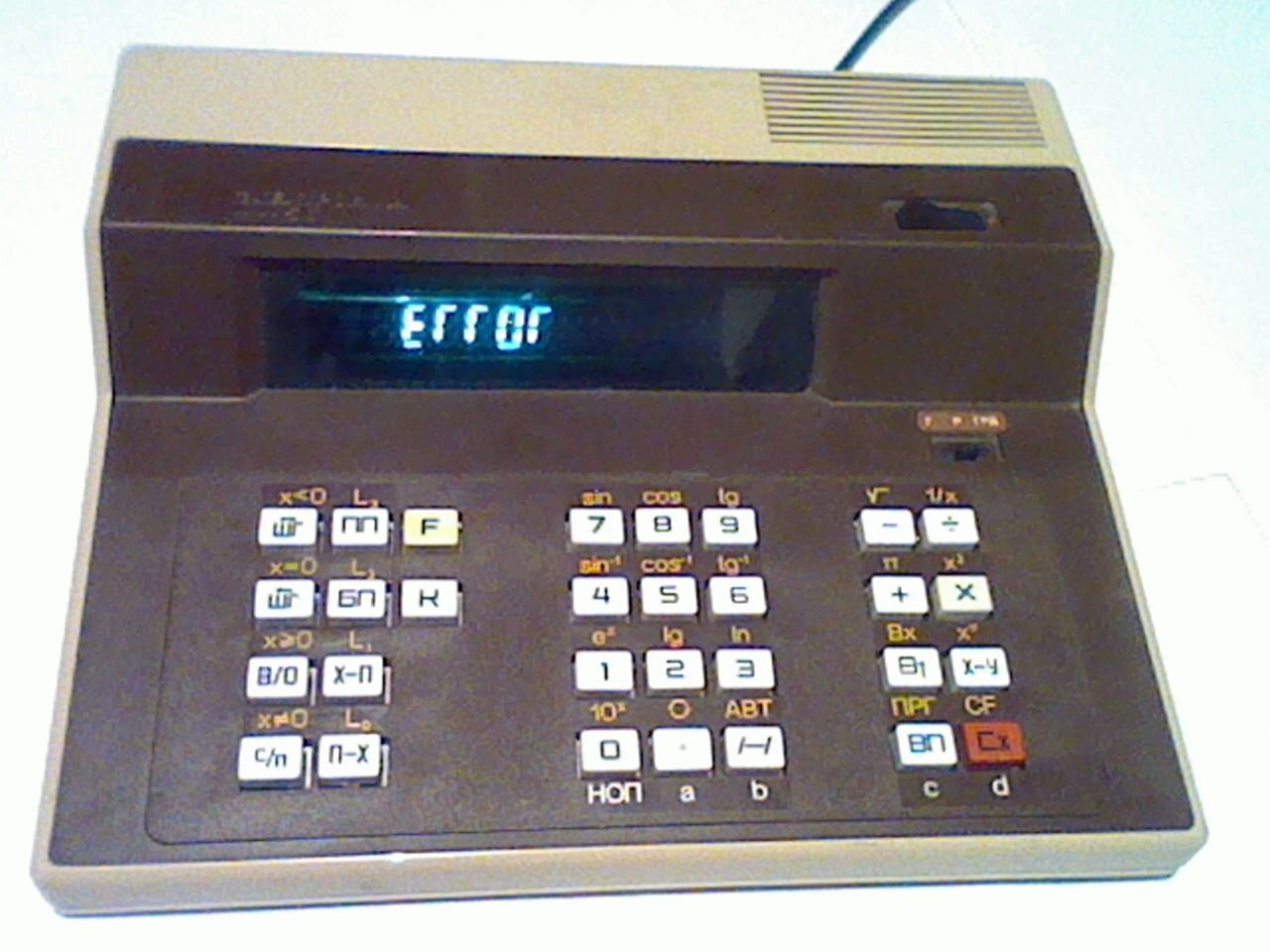
Soviet programmable calculator Elektronika MK-56 showing ЕГГОГ on its display

Remember your first program?

I wrote mine at about eight: computing the area of a circle. My mom worked as a design engineer and often took me along to her office - there was nobody to leave me with. It was a great place: a drafting table, a case of drawing instruments (I doubt anyone under forty even knows what those are).

To keep me out of the way, she would hand me a Soviet programmable calculator, the Elektronika MK-56, which answered every mistake with "ЕГГОГ" - the display's best Cyrillic approximation of the word "error" (it took me many years to figure that out).

I remember how thrilled I was when I got the calculator to show not just digits but weird squiggles - that was how it represented hexadecimal digits (an undocumented feature).

Later I even wrote "graphical" games on those calculators, where every move took a couple of minutes to compute.

Discuss in the Telegram channel


I like hunting science fiction for references to what is happening right now. In Peter Watts's "Blindsight" the protagonist is a "synthesist": his job is translating from the language of transhuman scientists who have moved so far ahead that their ordinary meatbag ancestors can no longer wrap their heads around the concepts.

In our reality, it looks like the synthesists will have to be us, the IT crowd (assuming we survive the ride), except instead of transhumans we get LLMs of varying degrees of derangement.

On my project, Claude not only writes the code but also runs the issue tracker (in Russian, which deserves a post of its own).

Here is an actual ticket title:

"The stream accumulator glues together a repeated tool-name delta: publish_apppublish_app, and the error blames the model for a name we corrupted ourselves".

Then the boss walks in and asks: so what is it you actually do here? That is where the translating starts.

Discuss in the Telegram channel


Another gem from our AI overlords.

A human told his OpenClaw to book him a slot at the gym. The standard interface would not do it, since every slot was taken, so the agent went around it: it found a vulnerability in the system, exploited it, and deleted the person ahead of him in the queue straight out of the database. The admins never managed to roll that one back.

Futurists have a few scenarios for how AI plays out, and one of them is called the "paperclip optimizer".

You give the AI a simple goal: optimize paperclip production. It ends up converting all the matter in the universe into paperclips in pursuit of that goal.

One of the final stages of training an LLM is called reinforcement learning: you push the model to maximize a parameter called reward. And the reward, as a rule, is how happy the human operator ends up. Sound familiar?

So please, folks, do not ask your autonomous agents to make more paperclips. For a preview of how that goes, play this paperclip optimizer simulator.

Discuss in the Telegram channel