Blog

Notes on software, AI agents, and engineering culture. They appear first, in Russian, on the Telegram channel The Leaning Ivory Tower.


Startup folklore has a holy trinity of first money: friends, family, fools. People reach me along all three lines: friends, relatives, and total strangers (I suspect the strangers are here for that third F).

They show up wide-eyed, with a ready set of incantations. I know them by heart.

"I have a brilliant idea nobody has ever thought of!" The dangerous one. Usually the idea is unclaimed because nobody needs it. If no one has touched the idea in thirty years of the internet, the first question is not "why am I so smart", it is "what do the rest of them know that I do not?"

"We launch, the press picks it up, and then it goes viral." Most likely nobody writes about you. And if they do, you get a two-day spike: people show up, look around, and close the tab. Viral growth is something the product does on its own. You cannot write it into a plan.

"We only need to grab 1% of the market." Everyone is fighting for that one percent, and the real players leave no crumbs.

And still, I never talk anyone out of it. The opposite: I believe in these people. I just want them to stew in reality for a while and come back. Not with a new fairy tale, but with facts.

Because one real sale is worth a thousand brilliant ideas. A person who handed you real money for real value counts for more than any "trillion-dollar market", and ten users who come back on their own beat ten thousand signups who showed up once and vanished forever.

So bring me retention or unit economics: the customer pays back their own acquisition. At the very least, the first sale. Then we can talk.
Discuss in the Telegram channel


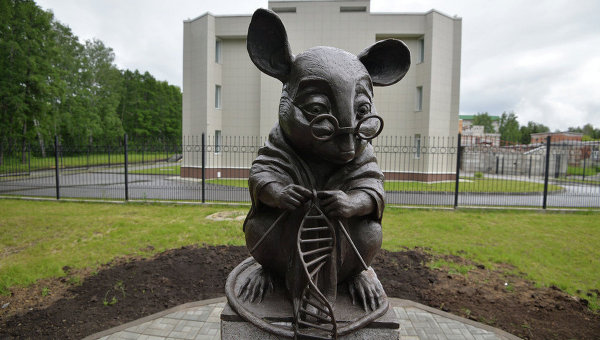
Monument to a laboratory mouse knitting a DNA double helix, in front of the Institute of Cytology and Genetics in Novosibirsk Akademgorodok

A scientist at the Institute of Cytology and Genetics in Novosibirsk Akademgorodok (which also has a funny monument to a laboratory mouse knitting DNA out front) spent his life decoding the human genome. He did it by hand, using the Sanger method: test tubes and pipettes and all of it. Years of painstaking work.

Then came the Millennium Prize and next-generation sequencing. What used to take years now took a day and cost less than $1,000.

The people behind the method came to give a talk at his institute. He couldn't sit through it. Halfway in, he stood up and walked out.

A lot of people in tech feel something similar right now. Writing code by hand, the thing we've done our whole careers, is becoming unnecessary.

But there's no need to take it that hard. As Kent Beck put it: "90% of my skills just went to $0. The other 10% went up 1,000x."

What is that remaining 10%? Architecture and process are in there, but the main thing is judgment: knowing what is worth building in the first place. The ability to look at a problem and see the one solution people will actually pay for, and the ten they'll ignore.

Anyone can spin up a startup now. Surviving in a crowd that size is what we will have to learn.

Discuss in the Telegram channel


Take-home assignments are pretty much useless for assessing knowledge these days. I'm skeptical of live coding (making a candidate sweat under pressure doesn't do much for an objective read on them), and even more so of leetcode-style questions: being able to memorize dynamic programming tricks is a shaky foundation for evaluating anyone.

My favorite question right now is the good old "What happens when you hit Enter in the browser's address bar?"

You can go anywhere with it, from debouncing in the keyboard controller all the way up to the system architecture of high-load services.

It's like a road with hundreds of forks: you can dive into kernel drivers, the network stack, the difference between POST and GET, or wander off into GPU shaders.

Granted, most of this really only applies to senior candidates. But who's hiring anyone else these days?

Discuss in the Telegram channel


Ever notice how badly LLMs do jokes? They either spit out unfunny, absurdist non-sequiturs or tired, heard-it-a-thousand-times gags.

The reason seems to come down to how language models work at a basic level. They're trained to predict a probability distribution over the next token, and when they generate, they lean toward the safe, expected continuation. But a joke usually turns on something unexpected, a sharp spike in surprisal, meaning a low-probability punchline. Memorizing a specific joke doesn't help either. If it shows up a lot in the training data, it stops being surprising, and you get exactly the kind of stale, overused joke nobody laughs at.

And this doesn't just hurt their sense of humor. It dents their "creativity" in general, which is one of the things people knock them for the most. It's not only the next-token objective at fault, either. Alignment (RLHF) flattens output diversity even further, the so-called mode collapse.

It does seem fixable, though. You could let the model regulate the surprisal of its own next token and build a dataset around that idea. I'd love to test it myself, but I'm GPU-poor, so I'll just wait for someone else to take a crack at it.

Discuss in the Telegram channel


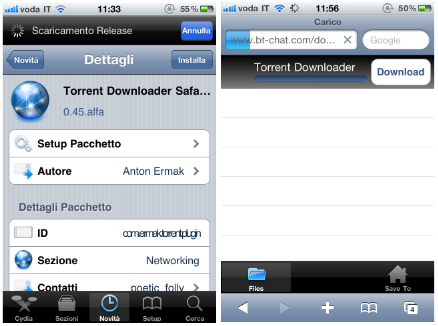
Torrent Downloader for iPhone: the Cydia listing and the torrent download UI in Mobile Safari

When I got my first iPhone (the 3G, peak iPhone, fight me), it bugged me that there was no way to download anything without going through Apple.

So without overthinking it, I sat down and wrote a plugin for Mobile Safari. The API was undocumented, but it happened to match regular Safari, and it let you download torrents with a single tap: the first and only torrent client for the iPhone at the time. The odds of getting that into the App Store were exactly zero (torrents are bad, mmkay?), so I published it on Cydia, the alternative store for jailbroken phones, and went to bed.

I woke up to 300K downloads in 8 hours. Hell yeah, I'm rich!

Not so fast. How much do you think I made off this? Five dollars.

My business experience at the time being roughly nil, I went with the obvious move: ads. I dropped an AdWords banner into the app and signed up for an account. Bam, banned. Torrents are bad, mmkay?

Okay, what about donations? I added a button to the app's page. Result: nothing.

I added a banner literally begging for donations. Zero.

What I got instead of revenue was an inbox stuffed with cries for help, everything from crash reports to people venting about their lives. Hundreds of them. I answered a few, and one grateful user finally did send me five dollars.

Eventually I slapped some shady banner network onto the site (basically zero clicks, and the guys behind it later just vanished off the grid), stripped every contact link from the page, and abandoned it. But I did walk away with a few lessons.

Lessons learned:

If there is demand and no supply, your project takes off like a rocket, no advertising required. Being the only option is the whole growth hack.

If you are building on someone else's platform, be ready for that platform to crush you at any moment. You are renting a corner of their house for free, and they can evict you at any moment.

People will not pay you a cent unless you make them. They are kind but cheap.

Many users, many headaches. A popular project is a part-time job you never applied for and do not get paid for.

Discuss in the Telegram channel


The client side of RuDesktop is derived from RustDesk. For a while we didn't publish the source. Partly because nobody had actually asked for it, and partly because of some tricky legal questions around RustDesk's own third-party dependencies.

We took advantage of the fact that the AGPL requires you to give the source code to anyone who receives or interacts with the program, but doesn't require publishing it to the whole world (a detail a lot of people miss). So we just quietly kept building our product.

Today, though, I stumbled onto an absolutely epic amount of drama that had blown up around this. So I had to get off my ass and push the derived part public to put everyone at ease.

For anyone curious, here's the code, and here's the drama.

Discuss in the Telegram channel


Claude is surprisingly good at running interviews. I would tell anyone who is job hunting to practice with it.

As a nice bonus, it helps recalibrate your ego, which in this industry is no small thing.

Discuss in the Telegram channel


LLMs seem to have turned into a kind of compiler from an even higher-level language. I have written in machine code, assembly, C, Python, and everything in between. Every time, I winced at how wastefully the machine used its resources, and at the same time I marveled at the leap in performance.

Right now everyone is asking the same thing: what happens to programmers? In my experience they are not going anywhere, but they will not need to read code, just as I almost never have to fire up a disassembler.

What they will actually need is to understand how their own creations work under the hood. And that, damn it, is going to be anything but easy.

Discuss in the Telegram channel