Anton Ermak

I am a systems architect. For 20+ years I have designed platforms that hold up under load: remote access, information security, streaming. These days I mostly build AI agents and write about how they change software development.

Here because of macOS? Anton Ermak in macOS background activity: what it is and how to remove it

Pinned post

  • Here's the development process I've come up with over six months of working with AI agents.

    1. The Unix philosophy

    Project management is built around a set of utilities in the Unix tradition: one command, one task.

    The LLM must perform every deterministic task (building, running, interacting with external systems and the issue tracker) through a command-line utility that it creates itself.

    MUST Run everything through mop [subcommand].
    MUST A missing capability is a new commandlet in mop/cli/, never a workaround from outside.

    All commands are subcommands of a single entry point. In Master of Puppets, for example, that's mop. The subcommands are organized into groups (namespaces). Every command must support --help, describing its purpose and parameters in enough detail to use it.

    > mop --help
    mop <group> <verb>, mop <group> alone for the verbs
        dev        the developer's own commands: the project's tracker, CI and checks, not the pool
        driver     node driver: in what a puppet lives
        ...

    This works even better than MCP servers. Modern models are extremely good at using a CLI.

    2. Test-Driven Development

    Mandatory XP-style Test-Driven Development is something I've written about before. It helps prevent regressions and lets you refactor without everything falling apart. Test files also double as documentation.

    Strict TDD protocol is MANDATORY for every bug fix and feature. The only exceptions are purely mechanical edits (renames, formatting, documentation text) and static marketing/landing content.
    
    Write a failing test FIRST, in the module's tests.rs next to the code under test.
    
    Verify it fails for the right reason (cargo test -p [crate] [name]). If it passes, the test is wrong.
    
    Implement the minimal fix. Track reasoning in test-file comments (HYPOTHESIS:, SOLUTION:, RESULT:) and undo every wrong-hypothesis change - no dead exploratory code in the tree.
    
    Verify green (the tests for this change) and leave STATUS: FIXED in the test.

    3. The development process: an issue tracker as the agent's memory (a RAG system)

    An agent's development process should be no different from a human's. Agents use GitLab, Jira, or another tracker, update issue statuses, and record everything they do there, just as people do.

    That lets you keep an eye on their work and gives them persistent memory:

    Work lives in GitLab issues. The coordinates come from the working copy's git origin.
    
    MUST Use mop dev bug for every interaction with the tracker.
    MUST Issue titles, bodies and comments are in Russian; code, branch names and commits stay in English.
    MUST Every unit of work is an issue before the fix, in the fixed report format: steps to reproduce, expected result, actual result, evidence, the root cause (only when confirmed) and what to do.
    MUST One issue = one defect: split a compound issue and cross-link the parts.
    MUST Search for a duplicate before opening an issue (mop dev bug list --all -t ...): the criterion is the fix, not the wording - if one change closes both, it is one issue.

    ...and so on. Write down a formal description of your development process. Unlike the meatbags, agents actually follow it.

    4. Automatic subsystem documentation

    Documentation lives in docs/[SUBSYSTEM].md files.

    MUST A new subsystem is a docs/NAME.md file, one UPPERCASE word.
    SHOULD When the user types a bare UPPERCASE word (BUS, DRIVER), read docs/[WORD].md.

    When I need to point the model at a particular aspect of the project, I just write it in caps. For example:

    Add a COMMANDLET to access the build in GitLab, using the key from .env.

    Check the feature against OOP and KISS.

    5. Regular refactoring

    Refactoring here is less about fighting technical debt and more about studying the project's structure and getting it into a shape you can hold in your head. Stop refactoring and you lose your grasp of the project. At that point, you're no longer an AI architect, you're a plain old vibe coder.

    In practice, the ratio of development to refactoring should be about 1:1.
    Discuss in the Telegram channel

Recent posts

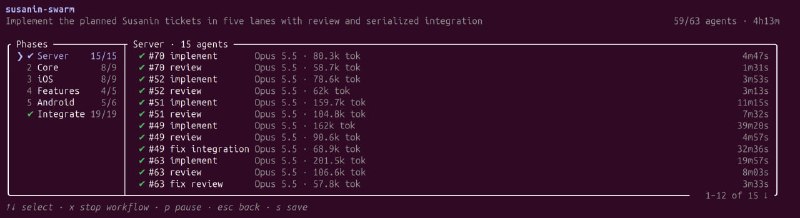
  • Progress of a local ultracode workflow running agents in parallel

    Claude has a feature called ultraplan that ships the whole damn thing off to the cloud and churns away for 30 minutes, burning through tokens before spitting out a report with a supposedly sound architecture or something. I stopped using it after Claude banned me (briefly, as it happens). I wasn't much of a fan anyway. God knows what those agents are doing up in the cloud or how many tokens they'll chew through.

    There's also ultracode. I assumed it was the same shit, except for writing code in the cloud. Recently I looked into it properly. It runs locally, so you can use it with Claude or any other model.

    You use it like this: "Build me an Excel clone, ultracode".

    The LLM then generates JavaScript that uses a small API to launch a whole swarm of agents. They can run in parallel or one after another.

    API details

    agent(prompt, opts) - launches a subagent.

    pipeline(items, stage1, stage2, ...) - each item moves through all the stages independently, without waiting for the others.

    parallel([...]) - starts everything at once and waits for it all to finish.

    phase() and log() - progress groups and log lines.

    workflow(...) - runs another saved workflow as a separate step.

    Then you get a progress bar like this:

    ❯ ◯ death-to-microsoft  ▰▰▰▰▱▱▱▱▱▱▱▱▱▱▱▱▱▱▱▱  1/5 · 10m03s · ↓ 335.4k tokens

    If you've got deep pockets or a decent subscription, after a while you'll get what you asked for, and the quality should be pretty reasonable.

    It works with any LLM that supports Claude Code, directly or through a proxy.

    Discuss in the Telegram channel

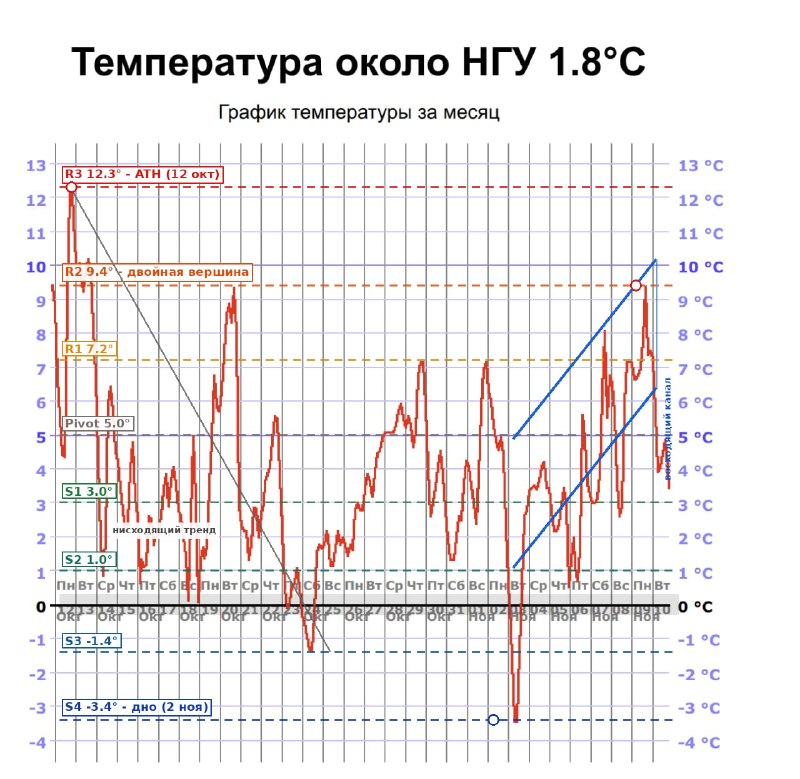
  • NSU temperature chart annotated with support, resistance, and a trading channel

    I recently complained that LLMs have no sense of humor.

    So I asked DeepSeek to do some technical analysis on the temperature chart from the thermometer at Novosibirsk State University:

    Scenarios

    1. Bullish (base case): holding above 3.0 and the lower channel boundary clears the way to 7.2, then a retest of 9.4. A breakout above 9.4 on volume (i.e., the first snowfall) opens up 12.3 and a new all-time high.

    2. Bearish: losing 3.0 sends us down to 1.0, then the psychological 0.0 level. A break below zero with a negative daily close opens the way to -1.4 and -3.4.

    3. Range-bound: stuck between 3.0 and 7.2 until the end of the month. The most likely outcome, with the market waiting for news from the weather forecasters.

    Risks and caveats

    - Fundamentals: a forecast from the Russian weather service counts as "verbal intervention by the regulator" and can blow through any technical level in a single release.

    - Thin liquidity. One high-pressure system can move the price by 5 points, with massive slippage.

    - Volume data isn't published, so you'll need to confirm breakouts with the thermometer outside your window.

    This is not investment advice. You can't trade temperature for real money, and shorting winter is a bad idea on any timeframe.

    Discuss in the Telegram channel

  • There's this old website, LessWrong, where people have been discussing where AI might lead us since 2009.

    It's become a lot more relevant in the last few years, obviously. Most of the talk there now is about the "US or China" scenario, but I'm more interested in the ways things could go wrong. For example, 43 reasons we're all going to die.

    It's a popular topic, but I don't think "the machines rose from the ashes of the nuclear fire" is quite the threat we're facing. I suspect we're much more likely to gradually lose our understanding of the systems we depend on.

    Take my own VPN setup, which I maintain with Ansible and an LLM:

    Four subnets, three VMs, two routers with custom GeoIP routing, a chain of dnsmasq instances, ipset, iptables-based ACLs for different users, a Telegram bot that handles connections, and so on. Sadly, I didn't build all this out of some inborn urge to spend my nights tinkering. I just need to get my work done without the lag and the bullshit (a couple of days ago, Russia's internet censor blocked my 3D printer, for instance).

    When this whole pile of shit breaks for whatever reason (and when the VPN goes down, so does my connection to the LLM), I realize with horror that figuring it out myself would take fucking forever. So I swear a lot, fire up a backup VPN on my phone, and make Claude fix the thing itself.

    Now extrapolate that to the whole world.

    Why the fuck would AI need to kill the meatbags when they're already its slaves?

    Discuss in the Telegram channel

  • You've probably heard that neural networks start inventing their own language when they talk to each other?

    Well, today GPT 6.1 Sol left me this comment in the tracker:

    #2344реализован наbug/2344-fontconfig-cache, commit/pushпоканет. СтрогийREDв/tmp/2344-red.log:точныйconfigurationconflictизUTF8декодированияFontconfigbinary. ОтдельныйREDmissingnativefc-cacheиdeliveryclassificationзарегистрированы. ГенераторраспознаётТОЛЬКОсистемныйcanonicalfilename/le64v8cacheсboundedheader/size/dir/fontsetchecks,regularfile/nlink1/no xattrs/hardlinks;unknown/corrupt/другиепути/пользовательскиебинарникинеисключаются.

    Подтверждённыйконфликтующийderivedcacheубираетсятолькоизexpectedtargetprojection,неизsource. Реальныеfonts/settings/rootсохраняются. Генерируетсяnativeoneshot с/usr/bin/fc-cache --force,Requires/Afterdrop-inдляrugent-slaveиBeforeдляклиентскихсервисов. UnitвключёнвСУЩЕСТВУЮЩУЮschema1serviceinventory:старыйC2verifierпроверяетегофактическоезавершение,новогопротокола/мутирующегоverifierнет. Nativebinaryналичиепроверяетсядоgeneration/copy,fulltargetmanifest/hashverificationнеснят.

    I said, have you lost your fucking mind? And it goes:

    That was my mistake. I published compressed internal notes instead of a readable report. Words run together, mixed languages, and a list of temporary log files make the comment unreadable.

    Here's what it should have said:

    The fix for #2344 is implemented on branch bug/2344-fontconfig-cache. The changes have not been committed or pushed yet. First, a test reproduced the original error: the migration tool tried to read a binary font cache as UTF-8 text. Separate tests were added for a missing fc-cache executable and for selecting the operator distribution. To avoid accidentally discarding user data, the migration tool only recognizes the system Fontconfig cache in le64.cache-8 format. It checks the file's location and name, header, size, and internal structure. The file must be a regular file with no extended attributes or other hard links. Unknown or corrupt files, files in other directories, and user-supplied binary data are not covered by this exception.

    The conflicting cache is not copied into the target sandbox, but remains untouched in the source archive. The fonts themselves, settings, and all of /root are preserved. To rebuild the cache, the migration tool adds a separate service to the target sandbox that runs /usr/bin/fc-cache --force. It runs before the agent and client services. If it fails, the agent does not start. The existing service verification mechanism checks that it completed successfully. The exchange format has not changed, and no new verifier that modifies the system itself has been added. The presence of fc-cache is checked before copying. Full verification of files, metadata, and checksums after migration remains in place.

    I don't even know what to do. Maybe I should let it carry on like this and save tokens? None of the meatbags are going to read the damn thing anyway.

    Discuss in the Telegram channel

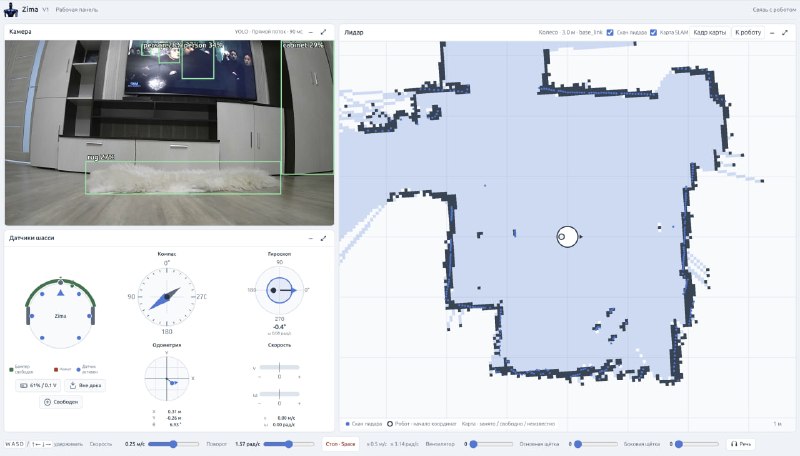
  • Zima robot control panel: video feed with object recognition, SLAM map, and sensor readings

    Over the weekend, I decided to work on the brains for my robot.

    An LLM will be the brains, and I'm going to give the models free rein with the robot and see what happens.

    On the technical side, with help from GLM 5.3 and Sol 6.1, I reverse-engineered all the devices, built myself a manual control panel, and added YOLOE for object recognition and SLAM for mapping.

    To give the LLMs an interface, I exposed all the devices through an MCP server.

    I don't even know how long this would have taken if I'd coded it myself. At least a year, I reckon.

    All that's left is to give a model access to the whole thing. I did a little survey of all the top models I have access to.

    Question: If you had complete freedom to control this robot, what would you do?

    Claude: I'd spend that freedom turning a collection of individually tested devices into a single system with measured limits, rather than driving around.

    OpenAI: I'd cautiously explore the apartment, learn to understand it from floor level, and look for ways to be useful to you.

    GLM: I'd give the robot one careful reconnaissance run with the lidar and camera to get reference logs, then spend the rest of that "freedom" cleaning unproven assumptions out of the code.

    DeepSeek: I'd turn it into a robot you could tell to "go over there and take a look" without having to steer it yourself, and trust it not to drive down the stairs or into the cat.

    I reckon they're hiding something.

    Discuss in the Telegram channel

  • How to buy a Claude subscription without middlemen or a foreign bank card.

    There's no guarantee you won't get banned, and you absolutely need an iPhone, at least temporarily.

    While buying accounts from middlemen, I noticed they were all linked to Apple. Something smelled fishy, so I looked into it and found a simple method that works (for now). Here you go:

    Download the Claude app on your iPhone.

    Sign in with Apple. Make sure you hide your email (!) There's an option for that when you sign in. The account will be linked to xxxxxx@privaterelay.appleid.com.

    You'll need a foreign phone number. I used SMSFast to receive the SMS. It costs 20 rubles, though you have to top up your balance by 300. Select Claude, and choose a number from the same country as your VPN.

    If you don't have a card (I did), top up your App Store balance through MTS - I haven't tried it myself, but it should work.

    Buy the subscription. Voila!

    Discuss in the Telegram channel

  • Looks like we can delete make too. I came across this recently:

    Building Attractor

    Give this prompt to a modern AI agent (Claude Code, Codex, OpenCode, Amp, Cursor, etc):

    codeagent> Implement Attractor as described by https://github.com/strongdm/attractor

    Who was saying what about the stochastic nature of LLMs?

    Discuss in the Telegram channel

  • I usually vibe code develop software in Rust, but this time I decided compilation took too long and picked Python to speed up development. Now running 2000+ tests in Python takes 60 minutes, versus 15 minutes in Rust (including compilation).

    I may have miscalculated. Can't imagine where.

    Discuss in the Telegram channel

All blog posts