Blog

Notes on software, AI agents, and engineering culture. They appear first, in Russian, on the Telegram channel The Leaning Ivory Tower.


The internet's entire cryptographic infrastructure spectacularly shit the bed yesterday: an Indian certificate authority (trusted by everything from Firefox to curl) issued 8 intermediate certificates with 3 to 8 bits of private key entropy (instead of 384).

Apparently, Honest Achmed couldn't get his CA registered honestly, so he had to register as "eMudhra Enterprise PKI, Post-Quantum Cryptography". Post-quantum sounds especially ironic in this context.

So I recommend removing "emSign ECC Root CA - G3" from your trusted certificates right away. It's still fucking trusted on every one of my computers and VMs.

And if you think MITM attacks are the preserve of ISPs and government agencies, I've got one hell of a story about money getting nicked from a crypto wallet because it downloaded an update without checking the server's certificate.

Edit: Checking for the vulnerability

$ curl https://dv-g3b-emudhra.we-have-a-problem.com/
Your client successfully connected to the site. That's bad!


Discuss in the Telegram channel


I came across a paper on how the harness, meaning the capabilities available in an agent (Claude Code, Codex, and so on), affects LLM performance.

The results are telling: a heavy harness hurts strong LLMs or is redundant, while weaker ones absolutely need a complex harness.

An interesting parallel: a senior developer can get by with a command line, vim, and grep, while a junior can't imagine working without a GUI and an IDE.

Discuss in the Telegram channel


DeepSeek usage: 1,033,653,641 tokens, 5498 requests, and a cost of $10.44

For value for money, nothing beats DeepSeek. Where else can you get a billion proper, usable tokens for $10?

And it's so fast that ten of my agents blasted through a fucking billion tokens in a couple of hours.

With Claude (Opus 5.4 on the x20 subscription), the same thing took all day and cost about the same.

Codex (6.1 Sol, $200 subscription) ate through the weekly limit in a couple of days, barely managing 300M a day.

So my goal now is ten billion tokens a day. Developer productivity is measured in tokens these days, right?

But I don't have that kind of cash!

Discuss in the Telegram channel


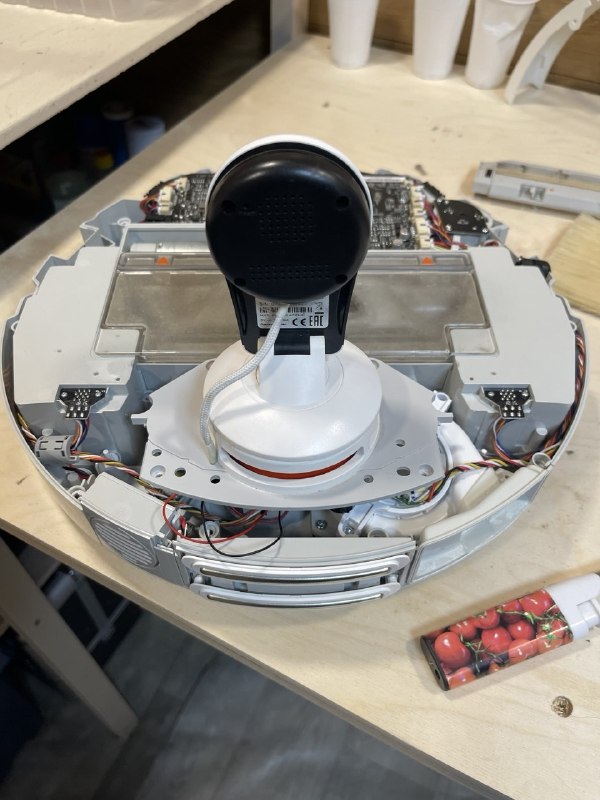
Roborock robot vacuum with an OpenIPC camera mounted on the lidar housing

Still upgrading the robot vacuum. To make its AI feel more at home, I decided to give it sight.

I had an old Wi-Fi camera from Rostelecom lying around, which I'd already rooted and installed OpenIPC on.

So I took it apart and soldered it to the lidar's power supply, which happened to be exactly 5 volts (and the board had some handy unused pads).

A couple of prompts later, all the sensors and the video feed are available in ROS2. It used to be a robot vacuum. Now it's a robot vacuum/security guard. Zima is getting closer.

Camera mounted above the lidar, with the power cable routed inside the body
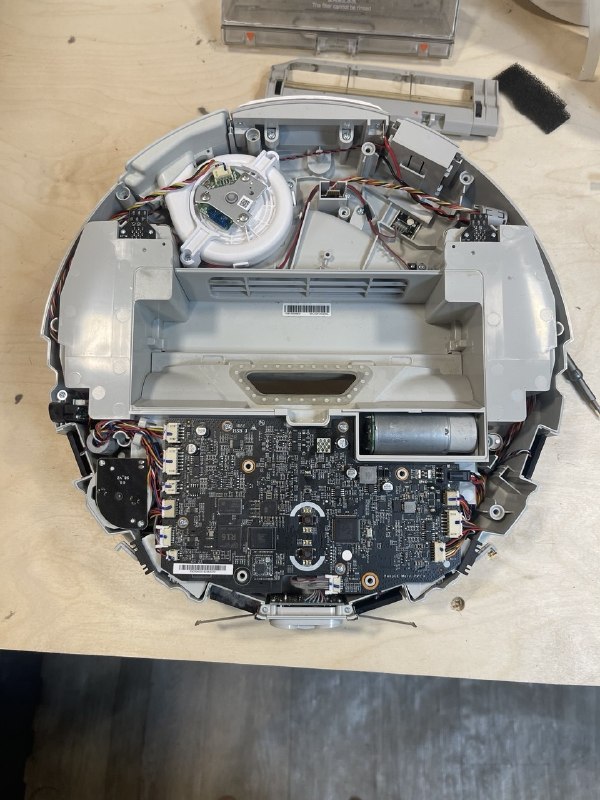
The robot taken apart: lidar, main board, and wiring
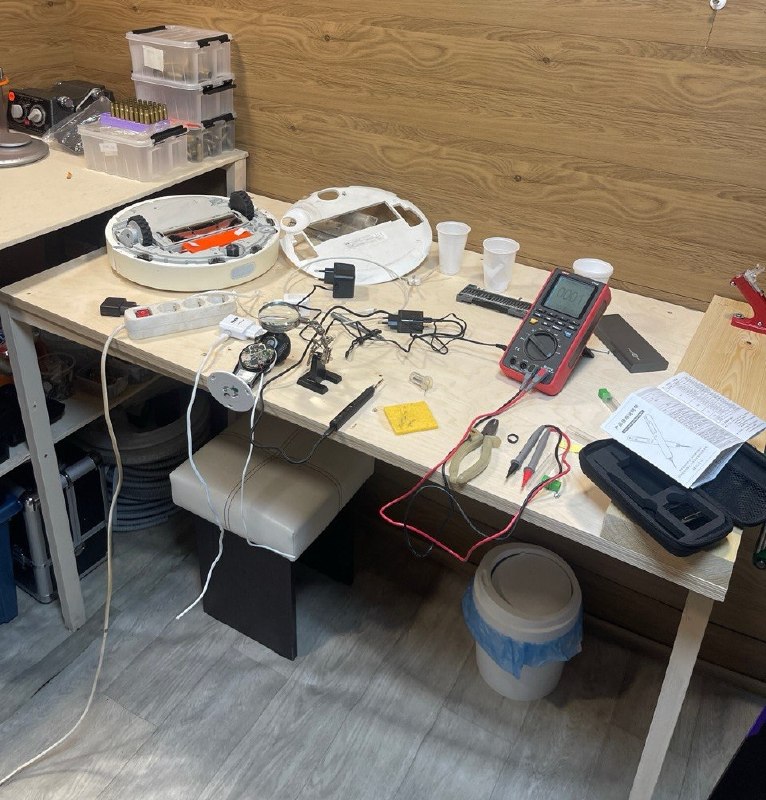
Workbench during the modification: camera, soldering iron, and multimeter

Discuss in the Telegram channel


For quite a while, I watched YouTube by routing it through a VPS at a local cloud provider, without any of those unfriendly VPNs.

Surprisingly, that was enough: Google Cache Network servers in Russia kept working just fine. Since they're hosted locally (the nearest ones are in Barnaul, as far as I could tell), the TSPU traffic-filtering boxes didn't affect them much. As a bonus, I got no ads (Google disabled them for Russia, the sucker).

But today the free ride ended: apparently, given recent events, TransTeleCom has stripped the GCN servers for parts (or Google itself decided to take them back before anything happened to them).

Oh well, what can you do? I set up a new route. In this complicated endeavor, our ever-friendly Kazakhstan is always ready to help.

Discuss in the Telegram channel


Speaking of changes of heart: you might remember Linus (yes, that one) writing that you can't trust a C++ compiler?

Here's a recent email from him:

From: Linus Torvalds

Date: Tue, 13 Oct 2026, 13:45:09 -0700

Subject: Re: [PATCH] docs: remove Assisted-by mentions

On Tuesday, 13 Oct 2026 at 13:16, Laurent Pinchart laurent.pinchart@ideasonboard.com wrote:

> This is about setting our expectations, communicating what we want and what we don't want.

No. You're talking about something completely different. This has nothing to do with "expectations", and everything to do with your own insecurities.

I don't understand this whole idiotic concept of "don't use AI for X".

Here's a new rule just for you: don't use compilers for any of your kernel patches.

Because if you can't show that you really understand what the machine does by writing assembly, I don't want to see your code contributions. You're obviously incompetent if you can't write it that way.

And by the way, you'd better not use an editor to write your commit message either.

Because I need you to show that you can write a good commit message without tools that let you easily erase text and hide the mistakes you made while typing.

Got it?

Otherwise, those tool-assisted commits clearly don't show that you understand what you're doing.

Can't you see how STUPID those rules would be?

So no. We're not going to introduce stupid rules like "you can't use tools for X".

My expectation is that people do their best, and I expect them to understand what they're doing.

But that understanding has very little to do with which tools they use.

And frankly, in my experience, the people I respect and consider smart don't shy away from new and interesting tools.

Linus

Twenty years on, the guy's gotten a bit wiser, though he still talks like an asshole.

Shall we vibe code some kernel patches? Oh, right, Russians aren't allowed in anymore. Still an asshole.

Discuss in the Telegram channel


I've always thought algorithm puzzles (aka LeetCode) in job interviews were one of the most braindead hiring strategies out there.

My go-to example was always Floyd's algorithm: "Determine whether a singly linked list contains a cycle in O(n) time using O(1) memory."

Sure, fast and slow pointers are a classic technique. But how the fuck are you supposed to come up with that unless you've memorized Knuth? It's like that infamous Google interview question: "You've been shrunk to 2 cm and put in a blender. How do you get out?" - "Jump out, for fuck's sake! High school physics, ha ha!"

Well, AI seems to have finished this off. HackerRank's founder and CEO has surrendered and raised the white flag:

I'm Vivek, co-founder and CEO of HackerRank. We're sorry we made you grind LeetCode endlessly. You can now see those words on billboards all over San Francisco.

HackerRank didn't invent algorithmic interviews. But we helped normalize a form of technical hiring that has candidates spending months solving problems with little connection to the actual job.

Technical interviews have come a long way: from questions like "How many golf balls fit in a Boeing 747?" to reading code over the phone, writing programs on whiteboards, and finally LeetCode-style problems.

Each stage brought interviews a little closer to real work. But for the most part, we were still measuring how well a candidate had prepared for interviews, rather than how well they could build software.

AI is changing the work itself.

Developers increasingly plan tasks with AI agents, build software with them, and review the results. They need to distinguish good code from code that needs work or is no good at all.

Hiring needs to change too.

At HackerRank, we're changing three things:

Tasks: moving from algorithm puzzles to working with real code repositories

Assessment will evaluate the ability to work with AI and make decisions, rather than code correctness alone

The candidate experience: an agent-based development environment in place of an IDE

Amen. I wonder what Yandex will have to say about this?

Discuss in the Telegram channel


When I decided to write a few components of a system in Rust, people looked at me like I was an idiot: "Where are you going to find developers? That is some obscure niche shit. You might as well write it in Haskell. C++ is the fucking industry standard."

Five years later, I can tell you that finding a Rust developer is much easier than finding, say, a Python developer. And it is not just because Rust has topped the most-loved programming languages list since 2016. Above all, putting Rust in a job ad attracts people who know their stuff, people for whom programming is more than a day job. We have never been short of applicants for that role.

Discuss in the Telegram channel


A friend turned posts from this channel into a podcast. With AI, of course. It came out great. Have a listen.

How vibe coding kills real engineering.

This episode dissects the hype around vibe coding, digs into the architectural hell behind 1,200 closed tickets, and asks why surviving the age of neural networks means becoming a "digital carpenter" with a strict test-driven development protocol.

The audio is in Russian. Download the MP3.

Discuss in the Telegram channel


A couple of days ago, Anthropic opened up access to Claude Code Projects. See the video.

If you have a Pro account, give it a try. This might be what programming looks like in the future. One telling detail: there is no code editor in the interface at all, unlike the crowd of IDE-centric tools such as Cursor.

My terminal-based Master of Puppets sucks by comparison when it comes to usability. Still, I have a couple of ideas about fixing that.

The latest version also has CLIProxyAPI built in. You can add accounts from several LLM providers and spread the load across them. There is LDAP authentication and a few other features, too.

It writes itself, as it should.

Discuss in the Telegram channel